|
Kaleidoscopes |
|||
|
Nate Bublitz, Natalie Gundrum, Chris Novales, Heather Schultz |
|||
|
Pringles Can Kaleidoscope |
Large Kaleidoscope |
||
| Sign Page | Construction Page | Sign Page | Construction Page |
| Kaleidoscope Budget | |||
When Sir David Brewster patented the first kaleidoscope in 1816, he could not have imagined the unique pleasures that his invention would bring to people. More than just a toy, kaleidoscopes have become an effective tool in color therapy. Many people use them to inspire their art, manage stress, aid in meditation, and assist in visualization therapy. However, seeing the endless designs appear and disappear make kaleidoscopes very unique. Some kaleidoscopes are so easy to assemble even a child can assemble one. Yet, others require much more time and effort. Furthermore, the brilliant wonder and excitement of the exclusive, ever-changing images that kaleidoscopes provide will never cease.
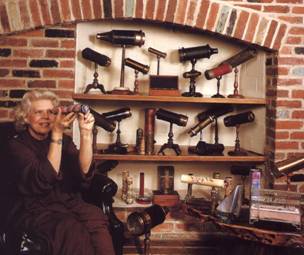
Kaleidoscopes are entertainment for all.
Although the ancient Egyptians have observed reflective symmetry in past centuries, a Scottish scientist did not invent the kaleidoscope until 1816. His name was Sir David Brewster (The History of Kaleidoscopes 1). When he was young, Brewster was considered a child prodigy, building his own kaleidoscope at the age of ten (Baker 8).
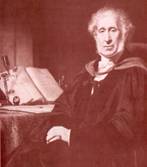
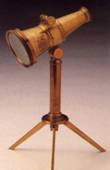
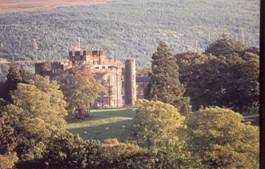
(From left
to right) A portrait of Sir David Brewster
Brewster’s Polyangular
Kaleidoscope
Stobo Castle in Peeblesshire, Scotland, where Brewster
signed his patent August 27, 1817
Brewster was a very diverse man,
often focusing his studying on scientific research, religion, philosophy,
education, optics, photography, writing, inventions, and even life on other
planets (Baker 8). His invention of the
kaleidoscope came about while he was experimenting with prisms and other
optical tools (History of Kaleidoscopes 1).
Brewster’s first invention consisted of a tube-like instrument, which
contained mirrors set at different angles.
These mirrors reflected the images of loose pieces of glass or other
colorful objects. When viewed through
the eyepiece, one could see many symmetrical patterns. Brewster named his invention the beautiful
form watcher, or in Greek, kaleidoscope.
After watching the growing sales of his new invention in
After the
popularity of the kaleidoscope decreased in
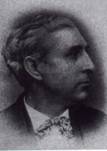
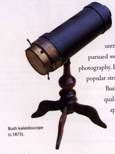
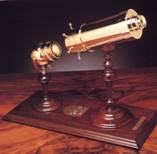
(From left
to right) Portrait of Charles Bush
The Bush
Kaleidoscope
Bush’s
Parlor Scope
Bush called his kaleidoscope the parlor kaleidoscope. These kaleidoscopes were built with barrels of black hardboard, containing a brass wheel mounted on top of a wooden stand, enabling it to rotate around in a circle. The interesting part of these parlor kaleidoscopes was the glass pieces inside. On the inside of these kaleidoscopes, Bush had about 35 different pieces of glass. One third of these pieces were filled with liquid, containing air bubbles that continued to move even after the kaleidoscope was set down.
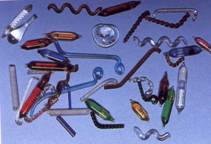
Various glass and liquid pieces used by Bush
The solid and liquid-filled pieces of the kaleidoscope were of various colors, making the kaleidoscope even more fascinating. Bush quickly registered his kaleidoscope for several different patents (The History of Kaleidoscopes 2).
Since its original invention, the kaleidoscope has gone through many different changes. Children have used its services as a toy. Adults used it as parlor entertainment. Artists, jewelers, architects and weavers used the kaleidoscope as a pallet for their work.
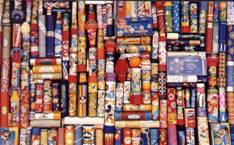
Kaleidoscopes are fun toys for kids of all ages
The kaleidoscope became popular during the Victorian Era. During this period, a home was not considered complete unless it had a parlor scope to entertain the family.
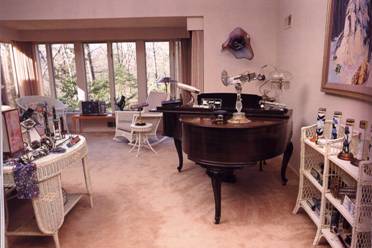
Homes were complete only if they possessed parlor
scopes during the Victorian Era
The kaleidoscope’s popularity decreased, however, when electrical appliances, such as, radios and televisions became more and more popular. One company however, worked its hardest to keep kaleidoscopes as an interest to many people. This company was the Steven Manufacturing Company. The Steven Manufacturing Company began making kaleidoscopes in 1946 and still makes them today (Baker 17).
In addition to revisions in the kaleidoscope itself, many changes have been made in the kaleidoscope’s inventors. When the kaleidoscope was first invented, the inventors were usually scientists. Today, the inventors are usually artists (Baker 22).
Another change is the purpose of the kaleidoscope. While Brewster’s invention was part of his research, often times the kaleidoscope is used to express the inventors’ feelings or emotions. Brewster, after inventing his kaleidoscope, registered for a patent and let others manufacture his invention as well. Today, great pride is taken into building personal kaleidoscopes (Baker 22).
The kaleidoscope’s “renaissance” began in the late 1970s through the work of many artists. Some of them were Steven Auger, Carolyn Bennett, Peach Reynolds, Carol and Tom Paretti, Doug Johnson, Howard Chesshire, Charles Karadimos, Dorothea Marshall, Bill O’Connor, Craig Musser, and Judith Karelitz (Baker 22). The Van Dyke Series II is one of the first kaleidoscopes made during this revolution.
Craig Musser, and glass blower, Bill O’Connor, were responsible for making the exterior of the kaleidoscope brass rather than cardboard. After completing this first major change, artists also began building larger kaleidoscopes that hold more color liquid filled glass. O’Connor began to study Brewster’s first experiments and drawings, developing his own crystals to place inside the kaleidoscope (Baker 23). Using his glass blowing furnace, O’Connor was able to create different, more magnificent colors, such as, cobalt blue, emerald green, ruby red, golden yellow, and fiery opalescent (Baker 24).
The O’Connor’s Series II consisted of 50 different editions of his kaleidoscope (Baker 24). To make his kaleidoscopes more presentable, O’Connor built a brass lamp and stand for his beautiful inventions. He made colors more defined by using surface reflection mirrors and fluoride-coated magnifying lenses (Baker 24).
However, O’Connor was not the
only one to make contributions to the building and improving of
kaleidoscopes. Auger used color
harmonics in his kaleidoscope, Kareltiz used
polarized light materials and filters for the first time, and Bennett put artwork
on the exterior of her kaleidoscope, while also inventing a wearable scope
(Baker 24). Johnson used clear and
beveled glass as the body of his scope, Chesshire
used three convex lenses and a prism for his scope, and the Parettis
built their scopes from finely fashioned and exotic hardwoods (Baker 24). Peach Reynolds invented the Camerascope along with a battery-operated, sound-activated
scope.
Kaleidoscopes can come in many different shapes and forms. Because of this, five types of kaleidoscopes can be determined by the endpiece (Baker 48). The first type of kaleidoscope is the teleidoscope.
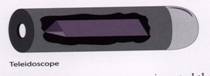
A model of a teleidoscope
In a teleidoscope, the endpiece has no color, only a clear lens. Anything the teleidoscope is pointed at turns into a kaleidoscope. Brewster said the teleidoscope was the purest form of a kaleidoscope. Teleidoscopes usually contain a three-mirror arrangement that is equilateral. These mirrors can be arranged in many different ways (Baker 50).
The second type of a kaleidoscope is the cell scope. Cell scopes have colored endpieces. Many different objects, including, tumbling pieces, liquid-filled pieces, or floating pieces can occupy these endpieces.
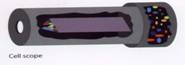
A model of a cell scope
Cell scopes are the most common type of kaleidoscope (Baker 50). Because of the moving pieces, cell scopes are able to create some of the most interesting images without too much repetition (Baker 50). The most common cell scope is the space tube, also known as the magic wand. In this kind of scope, the image of fireworks is shown. This image is created no matter what mirror arrangement is used (Baker 51).
The wheel scope is the third type of kaleidoscope. This kaleidoscope gets its name from the one or two wheels, which make up the endpiece. What makes this kaleidoscope interesting are the many different pieces and shapes of glass used to make breathtaking images (Baker 51).
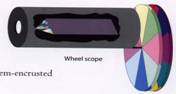
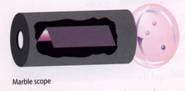
A model of a wheel
scope A
model of a marble scope
The fourth type of kaleidoscope deals with the objects in the endpiece. This kind is the marble or sphere scope. In these kaleidoscopes, marbles are used as the objects placed inside the endpiece. The images created by this scope come from using many different mirror arrangements and creating one’s own marbles (Baker 52).
Lastly, the projection scope is the fifth type of kaleidoscope. This type has the ability to project images onto other surfaces. Using a projection screen, any image of a video or picture is turned into kaleidoscope (Baker 52).
Many different shapes are used to make up the body of the kaleidoscope. Usually, these shapes are geometric shapes, such as, cylinders, triangles, squares, rectangles, and spheres. The more artistic and creative ones however, sometimes take the shapes of airplanes, trains, lighthouses, birdhouses, hot-air balloons, skyscrapers, or anything the artist can imagine (Baker 52).
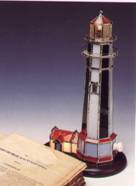
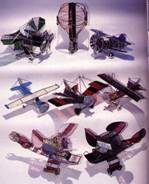
Lighthouses, airplanes, and hot balloons are some
unique styles of kaleidoscopes
The most popular kaleidoscopes are hand-held kaleidoscopes. Larger kaleidoscopes are beginning to become more popular. Smaller kaleidoscopes tend to be more popular because they are easier to pick up and look through, plus they are cheaper (Baker 54).
Kaleidoscopes can be built in many different ways. A kaleidoscope must consist of two or more mirrors set at different angles. If two mirrors are used and set at 30-degree angles to each other, the reflection created seems to be infinite (Kaleidoscope). As the angle degree changes, so does the image that the kaleidoscope creates. To add more effects to the kaleidoscope, many different arrangements can be done. Inside the tube, beads, colored glass, pieces of plastic, or even mixtures of water and oil, can be added and placed between two glass or plastic disks (Kaleidoscope). When the tube is rotated, items begin to tumble creating many different images (Kaleidoscope). Almost any material can be used to build a kaleidoscope.
One of the most important aspects of the kaleidoscope are the mirrors. Kaleidoscopes usually have two basic mirror systems. The first mirror system is the two-mirror system. This system displays just one central image. The mirrors are put into a “V” shape, and the numbers of reflections created depend on the angle the “V” is in. When the angles can be divided equally into 360, the best images are created (Baker 68).
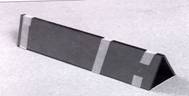
A display of a two-way mirror system
The three-mirror system is the second basic system of kaleidoscopes. When a person looks into a three-mirror kaleidoscope, the image is reflected throughout the entire field of view. The three-mirror system creates a “honeycomb” image that is continuous throughout the whole view. When the mirrors are set up in a 60-60-60 degree equilateral triangle, the kaleidoscope produces the simplest of repetitive images. This is different than when the mirrors are set up in a 45-45-90 degree triangle. When the mirrors are set up this way, they create a more complex pattern and merge triangular shapes with square shapes. To create the most interesting images, the mirrors are set up in a 30-60-90 triangle. The imagery is different at each degree. At 90 degrees, the image is fourfold, at 60 degrees, the image is six-fold, and at 30 degrees, the image is twelve-fold.
Other mirror systems include the four-mirror square system, which creates repeated square patterns. The same is for the four-mirror rectangle system, the only difference being the shape. When these two systems are used, a striped pattern is created. The tapered three or four-mirror systems create an illusion of three-dimensional spheres. Cylinder tubes that are lined with reflective material create a spiraling effect to the kaleidoscope. Because there are no angles, the image seems to climb as the viewer looks further into the tube (Baker 69).
The most difficult system to construct is the polyangular system. This system is a variation of the two-mirror system. Both mirrors are adjusted to change the angle of the “V” which also change the amount of symmetrical reflections. Although it is the most difficult to construct, this system provided the viewer with the most satisfying images.
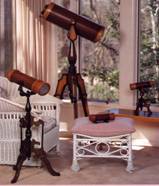
A display of polyangular
kaleidoscopes
Materials used to build a simplistic kaleidoscope can be formed from a Pringles can with its lid, a scissors, tape measure, Plexiglas, glue, mirrors – 1/8 inch thick mirror, cutting tools (glass cutter), masking tape, and “popcorn” foam (packing material). Depending on the type of scope to be made: two wheels, a wand, beads, paper clips, etc.
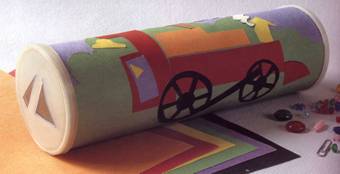
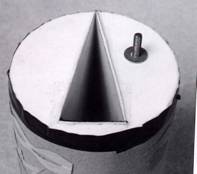
A simplistic kaleidoscope Foam used to keep mirrors in place
To construct the kaleidoscope;
first cut a hole in the metal end of the can, making it large enough to look
through by the viewer. Secondly, cut two
pieces of Plexiglas to fit
inside the can. Next, take the lid off, putting glue around the edges of one of the Plexiglas. Push the pieces of Plexiglas to the bottom of the can. Cut mirrors about two inches wide and 8 ¾ inches long. Then, lay them down with a 1/8 inch gap between them. Taking three eight inch pieces, place them across the mirrors with the excess tape hanging over the ends. Fold the mirrors into a triangular prism, having the reflective side on the inside, and using the extra tape to wind around the mirrors. Install the mirrors inside the can, using foam to keep them in place. Glue the remaining Plexiglas piece where the mirrors stop, near the lid.
Another type of kaleidoscope can be made with two film canisters, one clear, and the other dark. Other materials necessary to complete this scope would include: four plastic microscope slides, colored plastic beads, silver colored Mylar (able to reflect light) balloons, glue, and a knife. First, one must cut out the bottom of the dark canister. Then, trim a ¼ inch hole in the center of the lid.
In the clear canister, create a slot 1/3 of an inch from the bottom. One must make sure the cut is big enough to place the end section of a slide into the canister to hold the colored beads. Next, the reflective Mylar must be cut and glued to the three remaining slides. After this is done, install the slides into the dark canister in the shape of a triangle, making sure that the reflective surfaces are inside the triangle. Finally, the clear canister with beads should be slid onto the slides of the dark canister. (The clear canister must overlap the dark canister so the light does not leak where the canisters are joined together.)
Although kaleidoscopes are a form of art, it is obvious that they are constructed based on scientific principles. Kaleidoscopes are similar to architecture, both being an art form with creative expression in its end result. Each of these is also firmly rooted in sound engineering principles. Without this foundation, failure is sure to come.
Kaleidoscopes require much creativity, allowing room to incorporate personal taste. However, one must include the optical and mathematical principles for the project to become a success.
Even though kaleidoscopes are marvelous devices, kaleidoscopists, including, Dorothy Marshall think that the description of kaleidoscopes in discussions is lacking (Boswell 122). Octascopes can be used to describe any kaleidoscopes with eight-fold symmetry. Teleidoscopes (Greek for distant form viewing) describe any scope through which “forms” at a distance are viewed (Boswell 122).
Another problem with the terminology used to describe kaleidoscopes comes when people refer to the objects that appear inside the kaleidoscope. Many call them pieces, viewing objects, colors, chips, or bits. Usually, kaleidoscopes contain bits of colored glass; however, teleidoscopes, scopes through which colored oils of LEDs are viewed, use polarized filters (Boswell 122).
Along with the ability to use accurate terminology when referring to the parts of a kaleidoscope, complete accuracy extends in all areas when creating a kaleidoscope. One must be precise in the design, construction, and teaching about kaleidoscopes. Too often, kaleidoscopes are referred to as children’s’ toys, bypassing the idea that they are sophisticated pieces of work. Nevertheless, those that do research and obtain background information realize the uniqueness of kaleidoscopes and give them the respect and credit that they deserve.
When making kaleidoscopes, those who want the user to enjoy the product follow specific requirements. First and foremost, kaleidoscopes must be made as safe products, but this is not always the case. Kaleidoscopes need a protective eyepiece. This part keeps dust and dirt from reaching inside the reflectors. Secondly, the eyepiece protects the user from eye injuries that could be caused by sharp, loose pieces inside of the scope if the object was previously dropped or broken. Retailers, who know there may be a defect or have dropped a kaleidoscope themselves, may not always mention the dangers of the scope after it has been dropped for retail sake (Boswell 123). Therefore, plastic is indeed safe and a better choice, when selecting a proper eyepiece for a kaleidoscope.
Despite the dangers of using glass for the eyepiece, many artists still suggest glass eyepieces. However, in some cases, a kaleidoscope viewer could instantly be crippled or blinded by a damaged glass eyepiece.
Using a glass eyepiece, or even no eyepiece at all, may be cheaper, but not nearly as efficient as using plastic. Still today, some kaleidoscope artists do not understand the urgency to use a plastic eyepiece. When kaleidoscopists do not use plastic so they can receive more profits or simply because they are not well informed, they surely endanger the consumers. In reality, none of these reasons are inexcusable to endanger the vision of the buyer.
In addition to concerns about the eye protection of the user, other criteria that kaleidoscopists should be aware about are design and material criteria, precision and accuracy, environmental concerns, and more (Boswell 124). The general public is concerned about the use of rare, non-renewable materials in kaleidoscopes that could jeopardize the environment. However, as technology is becoming significantly advanced, it is evident that kaleidoscopists are making their products more environmentally safe.
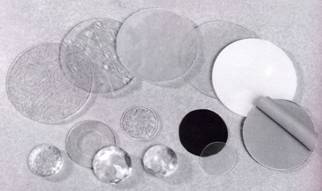
A collection
of good lens for kaleidoscopes
Kaleidoscopes have been designed, built, and cherished for more than 180 years. The exterior portion can be made of many materials, including wood, stained glass, and precious metals. The interior parts are filled with transparent, colored objects to bring wonder and excitement to the eye of the viewer. Kaleidoscopes have fascinating patterns, forms, movement, color, and light. The angles of the inside mirrors determine the number of reflections viewed. Therefore, while making a kaleidoscope, one may run across many bumps in the road. However, this is the fun and interesting part of the construction. Once the mirror system is installed, new creations can be seen in the kaleidoscope. Sharing this new product with others can be fun and exciting. Moreover, as the kaleidoscope renaissance continues to flourish, kaleidoscopists work hard to maintain their high standards to please their customers and colleagues with their unique work.
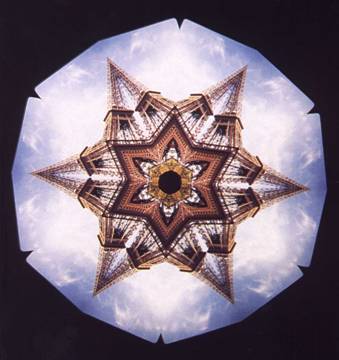
Fascinating and amazing creations can constantly be
made with the changing technology of kaleidoscopes.
Baker, Cozy. Kaleidoscopes:
Wonders of Wonder.
Boswell, Thom. The Kaleidoscope Book.
“Brewster, Sir David.” Collier’s Encyclopedia. 4th ed. 1991.
“Brewster, Sir David.”
Encyclopedia
“History of
Kaleidoscopes.”
http://www.duxterity.com/ec/history.htm
“Kaleidoscope.” Encarta Encyclopedia. Disc 2 1998.
“Kaleidoscopes.” Encyclopedia
Makers, Memory. Photo Kaleidoscopes.
Newlin, Gary. Simple Kaleidoscopes.
“The History
of Kaleidoscopes.”
http://geocities.com/lambyyang/history.html
Outline
I. Introduction
II. Sir David Brewster
A. His studies
B. Inventing the kaleidoscope
C. Growing sales
III. Charles Bush
A. Parlor kaleidoscope
1. Mounting
2. Glass pieces
IV. Uses of the kaleidoscope
V. Popularity of kaleidoscopes
VI. Changes in the kaleidoscope
A. Inventors
B. Purpose
C. Kaleidoscope renaissance
VII. O’Connor’s changes on the kaleidoscope
A. Size changes
B. Color changes
C. O’Connor Series II
VIII. Contributions to the kaleidoscope
IX. Five types of kaleidoscopes
A. Teleidoscope
B. Cell scope
C. Wheel scope
D. Marble or sphere scope
E. Projection scope
X. Body shapes
XI. Building procedures
A. Mirrors
B. Contents inside scope
C. Mirror systems
D. Polyangular system
XII. Scientific structure
XIII. Terminology
A. Problems
B. Accurate descriptions
XIV. Enjoying kaleidoscopes
A. Protective eyepieces
B. Criteria
XV. Conclusion