
By: Natalie Gundrum, Christian Novales, Nate Bublitz, and Heather Schultz
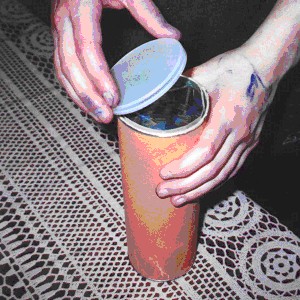
Look into the kaleidoscope through the viewing
hole. How many images do you see? Now, replace the confetti in the end of the
scope. Do you notice any changes?



 With the mirrors placed at
60-degrees angles,
With the mirrors placed at
60-degrees angles,
in
a three-mirror system, rotational symmetry is shown.

 When rotating
the kaleidoscope, the colorful pieces fall
When rotating
the kaleidoscope, the colorful pieces fall
 into
different positions, creating new and exciting designs.
into
different positions, creating new and exciting designs.
However, while viewing the pattern in
the scope, notice that each part, or section, of the pattern is symmetrical to
the other because as a person looks into a three-mirror kaleidoscope, the image
is reflected throughout the entire field of view. The three-mirror system creates a “honeycomb” image that is
continuous throughout the whole view.
When the mirrors are set up in a 60-60-60 degree equilateral triangle,
the kaleidoscope produces the simplest of repetitive images.