
Outline
1. Introduction
2. Mirrors and Lenses
3. Reflection and Refraction
4. Concave and Convex/ Converging and Diverging
5. Real Images and Virtual Images
6. Application to Life
7. Conclusion
The projects we chose to do are entitled “Shake Hands with Yourself” and “Lens Table”. These projects deal with the certain properties and effects of lenses and mirrors. At first, one may not realize how lenses and mirrors are incorporated so much in this life.
Lenses and Mirrors
Lenses and mirrors play an incredible part in how objects are seen. The main purpose of lenses and mirrors are to reflect or refract light. Types of mirrors and lenses are shaped a certain way in order to create an image that one sees—whether that image be real or virtual. The shape or the curve will be what determines how the reflected or refracted object looks. For example, a concave shape will bend light inward towards a focal point. Those images will appear upright and smaller than actual.
|
|
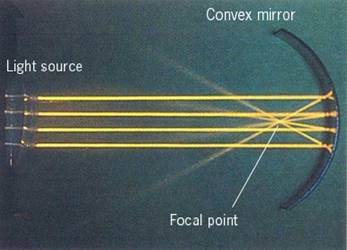
In contrast, a convex shape will bend light outward and reflect it away from the center. Those images will appear upright and larger than actual when the convex shape is close to a person’s eyes, but upside down when farther away.
|
|
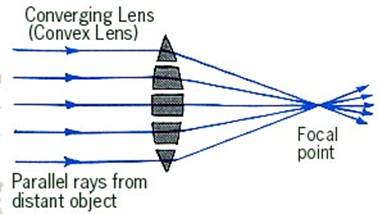
More of this will be covered in the section entitled Concave and Convex Lenses. If a reflection surface is flat then the image produced will be upright and the same size as the object it’s reflecting. The image produced is the same distance from the mirror as it appears and it is a virtual image.
|
|
The advantage with mirrors, however, is that they can be built with much larger diameters than lenses.
Reflection and Refraction
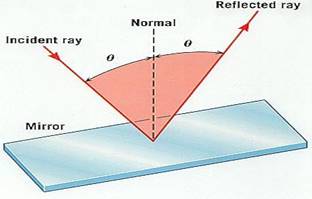
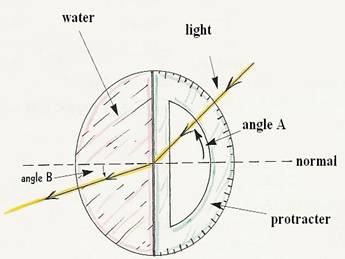
Reflection is the return of all or part of a beam of particles or waves when it meets the boundary between two substances. When looking at the diagram below, imagine that the incident ray is a person, the normal is a mirror, and the reflected ray is a reflection of the person. Mirrors have a surface that reflects the majority of the light that falls on it.
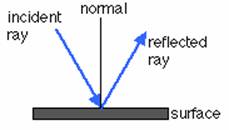
Refraction is the bending of a light beam that occurs at the boundary between two different substances, like air and water, when light strikes it at an angle other than 90 degrees. Light bends, or refracts, when the speed of light changes at the boundary between the substances. When a beam of light passes from air into water, it bends toward the normal but does not reflect.
Concave and Convex/ Converging and Diverging
Many people are familiar with a lens. However, there are two distinct types of lenses, concave and convex. In a concave lens, the structure causes the light’s rays to spread out or diverge. In the process of diverging, the light comes together as the light rays are approaching the principal axis at a parallel angle (as seen in Mirrors and Lenses). In this type of lens, the lens is thinner and flatter in the middle, unlike the edges. Not only can concave structures be found in a lens, but also in mirrors. A concave mirror increases the size of the object shown. This feature occurs because the mirror is bent inward. When viewing an object in a concave mirror, the object will appear upside down from a distance, yet right side up and larger when viewed at a closer look.
On the other hand, convex lenses have the opposite affect. Convex lenses cause light rays to come together, or converge (as seen in Mirrors and Lenses). In the process of converging, the light rays spread out as the rays are approaching the principal axis, a symmetrical horizontal line at a parallel angle. The convex structure brings on a thicker shape in the middle, and a thinner shape around the edges. In the same way as the concave mirror, a convex lens makes object appear upside down at a distance, but right side up at a closer look. However, convex mirrors curve outward and cause the object to appear right side up and a smaller size than the original object.
|
|
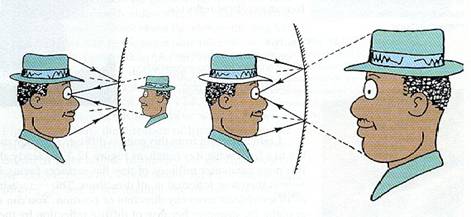
Concave and convex lenses allow objects to be seen from different viewpoints and angles. By doing this, one may be able to explore objects at a deeper angle and discover more about the object and their structure. These lenses are used everyday by human beings. In our eyes, a lens is used to help us see things in the world. They are also used in microscopes and telescopes. By bending lenses and mirrors different directions, the viewpoint of objects and the way one looks at them may be changed.
Real and Virtual Images
Images are separated into two categories, real and virtual. Real images are images whose rays of light comes together while virtual images are images whose light only seems to come together. Real images are formed when objects are placed outside the length of view of the convex lens. The intersections of the rays of light give the image its position.
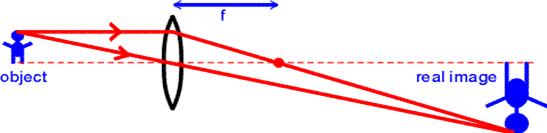
This
position can be found thorough the mathematical equation as follows:
 . di stands for the distance from the image to
the lens. do stands for the height of the image. And f stands
for the focal length in a convex lens. On the other hand, virtual images
are formed from lenses that are concave or by placing an object inside a
convex lens’s focal length. Concave lenses allow the image to appear
shrunken, while object place inside the focal length of a convex lens forces
the image to appear enlarged.
. di stands for the distance from the image to
the lens. do stands for the height of the image. And f stands
for the focal length in a convex lens. On the other hand, virtual images
are formed from lenses that are concave or by placing an object inside a
convex lens’s focal length. Concave lenses allow the image to appear
shrunken, while object place inside the focal length of a convex lens forces
the image to appear enlarged.
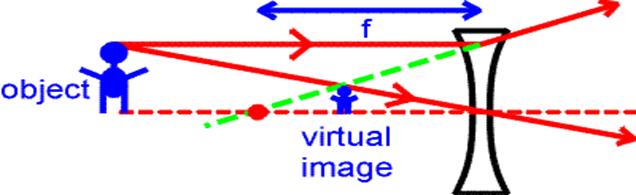
Virtual and real images are also found in mirrors. Concave and convex mirrors can be used to enlarge your image, such as beauty mirrors, and to shrink the image, such as mirrors used to view a whole room for security purposes. The image that can be focused on the mirror is a real image. An image that is seen behind the mirror, and is not and cannot be focused on is a virtual image.
Application to Life
 Lenses
and mirrors play a vital part of everyday life for people. Some people
depend on glasses to be able to see or correct their eye sight. Convex
lenses are used to correct hyperopia or farsightedness, while concave lenses
help correct myopia or nearsightedness, and cylindrical lenses correct
astigmatism. The
convex lens can
also allow people to see tiny, microscopic organisms. The microscope uses
multiple lenses. The closest lens to the organism creates the image, and
then the lens that you look through, magnifies the object. The microscope
works better when the product of magnification of the two lenses gets
higher. The formula is
Lenses
and mirrors play a vital part of everyday life for people. Some people
depend on glasses to be able to see or correct their eye sight. Convex
lenses are used to correct hyperopia or farsightedness, while concave lenses
help correct myopia or nearsightedness, and cylindrical lenses correct
astigmatism. The
convex lens can
also allow people to see tiny, microscopic organisms. The microscope uses
multiple lenses. The closest lens to the organism creates the image, and
then the lens that you look through, magnifies the object. The microscope
works better when the product of magnification of the two lenses gets
higher. The formula is  na(cond) < na(obj) R is the resolution in microRS, L is
wavelength of light, na(cond) is the numerical aperture of the condenser and
na(obj) is the numerical aperture of the objective.
na(cond) < na(obj) R is the resolution in microRS, L is
wavelength of light, na(cond) is the numerical aperture of the condenser and
na(obj) is the numerical aperture of the objective.
People use mirrors for many different purposes in life. For example, if one plays pool often, he may decide to bounce a ball off the side of a pool table like a light ray reflects off of a mirror. To bank the cue ball into another ball (the object ball). Imagine you are shooting at the mirror image of the object ball.
|
|
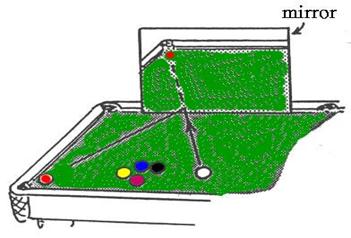
Also, in the morning, you look at yourself in the mirror to see how you look and to see what you may have to do when it comes to your hair. Mirrors, along with lenses, are used in telescopes and binoculars. Light comes in through the lens and is then reflected off the mirrors inside that give a bigger picture from distant objects. Mirrors are also used when driving your car. Have you ever looked closely at the right side view mirror in your car? It has some writing on there that goes something like, “object may be closer than they appear.”
|
|
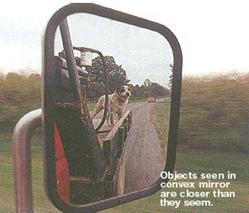
Well, the angle of the mirror on the side of the car, and the distance away from the mirror to the driver’s seat causes the image reflected to appear smaller than what it really is, making close objects appear farther away from the car. The uses for lenses and mirrors are important for people in their everyday life.
In conclusion, we can see how important lenses and mirrors are in our lives. Lenses and mirrors have certain shapes that reflect or refract to create different images.
Works Cited
Clark, Lawrence. The World of Science: Physics in Everyday Life. Oxford: Southside, 1989.
“How The Eye Works.” 10-26-04 http://www.steen-hall.com/g-howeye.html
“The reflection and refraction of light.” 7-27-99. 10-26-04 http://physics.bu.edu/~ duffy/py106/Reflection.html
10-26-04 http://www.edmundoptics.com/US/onlinecatalog/DisplayProduct.cfm? productid=1747
10-26-04 http://faculty.virginia.edu/teach-present-bio/LightRefraction.html
10-27-04 http://electron9.phys.utn.edu/136/modules/module10.htm
1-12-05 http://sol.sci.uop.edu/~jfalward/physics17/chapter12/chapter12.html
1-13-05 http://www.pa.msu.edu/courses/2000spring/PHY232/lectures/lenses/images.html