The Parabola and its Significance
I. Introduction
a. Definition
b. Purpose
II. History
III. Parts
IV. Equations
a. General Equation for a Conic Section
b. Horizontal Vertex
c. Vertical Vertex
V. Real Life Application
a. Satellites
b. Radio Telescopes
c. Liquid Mirror Telescopes
VI. Conclusion
Despite
some belief, numerous technical areas of math have vitally influenced the
modern world around us and therefore play crucial roles in our lives. Yet, as students inattentively listen in math
class to what they feel is useless information, they also fail to comprehend
the significance of such topics and their many real world applications. However, among these fundamental and
imperative math topics, parabolas are one of the most essential fields of study
that can be found in numerous areas of life and serve many critical
purposes. However, to fully comprehend
these purposes and the many advantageous opportunities parabolas present, it is
essential to understand the basic meaning and definition of a parabola.
The dictionary
intricately defines a parabola as a plane curve formed by the intersection of a
right circular cone and a plane parallel to an element of the cone or by the
locus of points equidistant from a fixed line and a fixed point not on the
line. More simply stated, however, a
parabola could be explained as a set of all points that are equidistant from a
fixed point, the focus, and from a
fixed line, the directrix. These terms will become clearer later in this
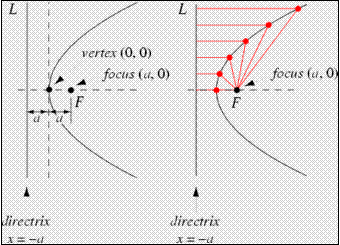
study. A basic parabola and its parts
can be seen and more easily comprehended by examining Picture 1. The Equation for a Parabola in
Picture 1: Basic Diagram of a Parabola
The purpose of this study is to
explore the world of parabolas from the very traces of their existence to the
many intricate uses they serve
today.
This study will take a comprehensive look at the parabola’s intricate history,
unique parts, equations, and real life applications
The intricate history of the parabola dates back centuries and has been developed and studied by some of the most famous and highly regarded names in history. One of the most influential developers of the parabola, however, was a man named Menaechmus. Menaechmus was an apprentice of both Plato and Eudoxus and a tutor to Alexander the Great who stumbled on the uses of a parabola when trying to solve a problem by geometrical means. When he was trying to duplicate the cube by finding the side of it that has an area double the cube, he resorted to using parabolas when all geometrical methods failed. In essence, he attempted to solve the equation x3= 2 and therefore attempted to achieve cube duplication. After realizing that the usual methods of a ruler and compass were not adequate to find an answer, he finally solved it by finding the intersection of the two parabolas x2=y and y2=2x.
Menaechmus also
played a valuable role in the history of parabolas through his study of conic
sections. These were conceived while trying to answer three of the most
boggling mathematical questions of the day:
trisecting an angle, duplicating a cube, and squaring a circle. However, numerous other people at the same
time were experimenting with and studying parabolas.
Apollonius was the
first to base the three conic sections, parabola, hyperbola, and ellipse, on
sections of one circular cone. Pappus
considered and developed both the focus
and the directrix of the parabola as
seen previously in Picture 1. Pascal considered the parabola as a projection of
a circle and Galileo showed that projectiles under the influence of gravity
follow parabolic paths as is evidenced in the study of Physics. Gregory and
Many unique parts of a parabola play a significant role in the development of its shape and the cause of its behavior. The first part of a parabola is the vertex, which varies depending on the specific characteristics of a given parabola. However, in every case the vertex is the intersection of the parabola and its axis. However, in a parabola that possesses the characteristic of opening upwards and is oriented vertically, the vertex is the point where the curve reaches a minimum. Conversely, in a parabola that opens downward, the vertex is the point where the curve reaches a maximum.
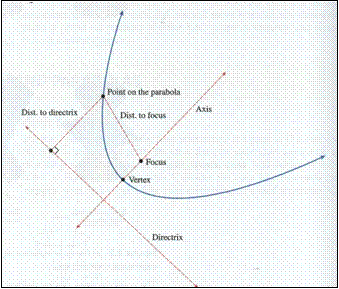
There are many other parts of the parabola, which not only aid in its definition but also allow it to be understood more clearly. The focus is a point found in the interior of the parabola on its axis of symmetry and the directrix is an imaginary line perpendicular to the axis of symmetry. These two parts compliment each other when understanding why a parabola takes on its certain shape. When analyzing these two parts it should become clear that the distance from the focus to the parabola equals the distance from the directrix to the parabola. This can be more easily seen by analyzing Picture 2, a more in-depth diagram of the parabola and its parts.
 Picture
2: More In-depth Diagram of the Parabola
Picture
2: More In-depth Diagram of the Parabola
The next part of a parabola is its zeros, or x-intercepts. These may sound challenging to understand, but their meaning is virtually defined in the term itself. The zeros of a parabola are where the parabola’s Y value equals zero and therefore the specific points where the parabola intersects the X, or horizontal, axis. These are also commonly called “roots” because they make the equation that forms the graph zero as well. Therefore, to obtain the zeros, you simply solve the equation of the graph equal to zero.
In Physics, parabolas are frequently used to predict the distance that objects under the influence of gravity travel while in projectile motion. Parabolas also tend to obtain numerous characteristics and specific behaviors.
One of the characteristics that they possess is eccentricity, commonly used in the study of conic sections. Eccentricity is a parameter associated with every conic section. It can be thought of as a measure of how much the conic section differs or deviates from being perfectly circular. In a parabola, the eccentricity is merely the ratio of the focal length to the semi axis. To find the eccentricity of conic sections the following equation is used:

where a is the semi-major axis, b is the semi-minor axis, and c is the distance from the center of the conic section to the focus. However, since the semi axis on a parabola is the same length from the vertex to the focus, the eccentricity of a parabola is always going to be one. The final part of a parabola is its axis of symmetry which is the line passing through the focus and perpendicular to the directrix. This, as its name implies, is the line of symmetry of the parabola.
Numerous equations apply and play significant roles when studying parabolas and other conic sections. A conic section is defined as the intersection of a plane and a cone. However, by changing the angle and location of this intersection, it is possible to produce a circle, ellipse, parabola, or hyperbola. In addition, the general equation for a conic section is as follows:

The type of conic section an equation possesses can be found by analyzing the discriminant of the function and by analyzing the answer given from this discriminant. To find the discriminant, the following equation is used:

When analyzing the discriminant, if it is less than zero, the function is an ellipse, circle, point, or no curve. If it is equal to zero, it is a parabola, two parallel lines, one line, or no curve. Finally, if the discriminant is greater than zero, it is a hyperbola or two intersecting lines. However, two other specific equations apply to conic sections and more specifically parabolas. The horizontal vertex equation for a parabola is as follows:

This is the standard form of an upward or downward opening parabola. Moreover, if p is greater than zero, the parabola opens upward; if p is less than zero, the parabola opens downward. Therefore, for this equation, the focus is found at the point (0,p) and the corresponding axis is the y-axis. Since parabolas that open to the right or left are simply inverses of upward or downward opening parabolas, the vertical vertex equation of a parabola is as follows:

The variable, p, for the previous equations is equal to the directed distance from the vertex to the focus of the parabola. This is also commonly known as the focal length. However, in this equation, the focus is at the point (p,0) and the corresponding axis is now the x-axis. For both of these equations, the directrix remains y = -p and the focal length and width remain equal.
Parabolas are easily applicable to many important devices, and have a major effect on everyday life. Most importantly, however, they are instrumental in satellite dishes. Because the purpose of a satellite is to receive signals and reflect them to a specific receiving location, it needs to be able to collect and reflect data from any point on the dish. Because of the shape of a parabola, it is ideal for this purpose. Because of the parabola, we now have cellular communication, instant video and audio transfer, and many other things that make daily life easier for many people.
Parabolas are also used in the radio telescopes used to receive data from orbital satellites. They consist of a parabolic dish with a large antenna protruding from the center. The signals transmitted from the satellite reflect off the telescope’s dish, and the beams are always focused to the tip of the antenna, where the information goes down into the receiver so it can be processed and stored electronically.
Another use for parabolas is in liquid mirror telescopes. These are used to catch images from space, watching for tiny particles of orbital space debris. It can create clear images of objects only one and a half centimeters in diameter. It uses spinning liquid mercury, because any liquid spun in a container at a high velocity will form the shape of a parabola. Cushioned with compressed air and a layer of plastic Mylar, this mirror of liquid mercury focused vertically at the sky can pick up high resolutions from far into space.
It can be easily seen that parabolas
present many significant opportunities and advantages that affect our
day-to-day lives immensely. Moreover,
with the ever-increasing amount of technological advances, parabolas are sure
to continue playing crucial roles in the future as well. These are merely three of the many practical
uses that we felt were most valuable.
From the most simplistic of flashlights to the most intricate of
satellites, parabolas present us with numerous opportunities that we would be
lost without in the modern and sophisticated world around us.