By: Katie Bellin, Anna Kodet, and Sarah Eastman
History of the Soda Can
|
|
Most agree that the Clicquot Club Ginger Ale can was the first soda can produced for retail distribution in the late 1938. Another candidate for first can came from the brand named Dairy Selts. It is unknown whether actual retail distribution occurred for Dairy Selts, as the only known example is thought to have been a salesman’s sample can. Another intriguing possibility is Coca-Cola’s 16 and 32-ounce cans, which are known to exist. In 1948, Pepsi Cola was one of the first to jump into the can making process, hoping that they would gain a larger share of the soda market, which was dominated by Coca-Cola. The introduction of Pepsi in cans was a huge gamble as the cans retailed 3 for 25 cents; nearly double the price of bottles at the time. The idea of Pepsi in cans ended in 1950 as a dismal failure, the cans leaked and sometimes exploded on store shelves. |
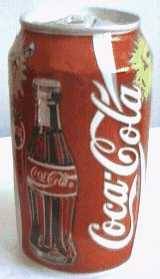
The big canning companies
would not give up the idea of the can.
The potential sail of 25 billion soda cans a year didn’t hurt the cause
for finding a soda can that works. By
the end of 1951, a much better can was developed. This can could
withstand the higher pressures of carbonated pop.
In early 1952 Cantrell
& Cochrane was a well-established soft drink manufacturer. It introduced Super Root Beer and Super Coola in cone top cans in the
Although most of the
larger soda companies were canning their product by 1956, the 2 largest, Pepsi
and Coca-Cola still resisted cans. Pepsi still resisted because of their
earlier failure and Coca-Cola did not want to lose their reputation. By 1960 Royal Crown was the largest canner of
soft drinks. Pepsi, 7 Up, and Coca-Cola, the three remaining giants realized cans
were the future. They finally gave in
and began canning by the end of the 50’s.
Source: http://www.canconnection.com/
To make our Coke can, a rectangular piece of metal is cut out of a large sheet of metal, and curved into a cylinder. Then the top and bottom are put on. The rectangular piece of metal must be 400cm2 in area, and the can must hold 355cm3. The equation using the area of the rectangle would be y=400/x (see chart below). The height of the can will be y, while the base of the can’s radius will be r = x/(2π). The equation of the volume of the can will be
y=1420π/x2
(see
chart below). The
two lines intersect at (11.152654,35.865903). This means that the height
of our soda can will be 35.865093 and the circumference
will be 11.152654. Making our soda can tall and thin.
| y=400/x | y=1420π/x2 | ||||||||||||||||||||||||||||||||||||||||||||
|
|
